

Hike #5: Ethical Considerations in Advertising. Where to draw the line? Is there a line at all?
Welcome back fellow hikers to a new week of your favorite marketing blog. In this edition, we will talk about a subject that I'm sure you are all familiar with, which is ethics in advertising. In order to ease into this topic a bit more, I will sketch you an image of the role ethics play in modern-day advertising and how it influences the public or you as an individual. But before we do so, let's dive into the definition of ethics first. What are ethics to begin with?
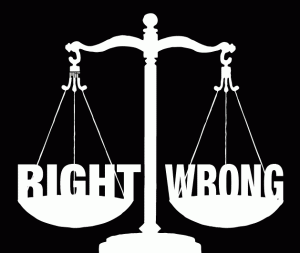
Ethics consist of the values and principles that guide our behaviors, which we can utilize in order to know the distinction between right and wrong. Or in other words, the unwritten guidelines of society (lecture). However, countries around the world have different approaches to ethics as each nation has different values that are dominant within their culture. For example, countries such as the UK, Sweden, Germany, Finland and Poland valued life satisfaction the highest. Whereas Russia, Norway, Iceland, France and Austria had health as their top priority. In northern American countries, there's less unity in values. As the US values life satisfaction the highest, Canada prioritized health and Mexico values environment the most (O’Connor, 2015). Therefore, when companies put out their marketing campaign in a certain country it is useful to know what the main values in the country are. As it could mean the difference between a successful campaign or a painful disaster, possibly resulting in backlash as well.
Ethics: A double edged sword that must be treated with caution
As you can probably imagine, ethical considerations should be treated with caution when a company decides to put out a marketing campaign, especially when this marketing campaign will be released in multiple countries or even multiple continents. So how do companies navigate the tight rope that is ethics in their advertising? Brace yourself hikers, we are going for a deep dive into all the do's and don'ts for ethics in advertising. In this way, providing you with a better understanding of how ethics can be used effectively in advertising. Which can be leveraged to achieve business goals in a more efficient way.
Do's:

Do #1: Collaborate with trustworthy journalists / incorporate high-quality journalism
This might not the first thing you would think of when considering ethics in advertising, but it is important nonetheless. It is about placing your advertisements in a context that signals trustworthiness and funded research rather than unfunded claims or possibly harmful intentions. This can be achieved by collaborating with sources that provide funded claims and proper research. I this way, brands can increase the trustworthiness of their brand among consumers as they are linked to reliable sources. If a brand fails to do so, it can gain reputational damage by being associated with news channels that are untrustworthy or being accused of endorsing content that isn't ethical or informed (Denysenko, 2024).
Do #2: Practice what you preach (Honesty/Transparency)
This aspect is mainly focused on recognizing your brand values, your target audience an how to convey them to your audience in an ethical way. This can be achieved by actually backing up the message that you are trying to send out using your advertisements (Denysenko, 2024). So, if a brand signals that they their product is completely child-labor free and is produced in honest collaboration with the producers, the brand should back this up by actually investing money to achieve this goal. For example, if you are a chocolate brand and you want to ensure a proper work environment and wage for the farmers that work on the cocoa fields. It is essential to set money aside to let representatives visit these venues to ensure this work environment and create proper regulations for wage and what should and shouldn't be happening on these plantations. The bottom line here is to make sure that the brand is actually doing what they say they value in the advertisements to make sure that brands maintain their reputation of trustworthiness among customers. Honesty in one of the values that brands should keep in mind when putting out their ads, in order to avoid misleading or deceptive (Bradford, 2024).
Do #3: Make sure to keep an eye out for human dignity and the companies' social responsibility
With human dignity it is meant that it should be avoided to purposefully exploit, or manipulate customers (Code of Ethics & Standards - Canadian Marketing Association, n.d.). For example by means of deliberate deception (Bradford, 2024). This can be the case when a company promotes their products through the usage of popular social media or influencers to promote products that could possibly be harmful or are not even used by the influencers that promote them. Another aspect that should be kept in mind is the fact that companies should remain cautious when it comes down to their social responsibility and the people they are targeting (Bradford, 2024). For example, when companies of products that have possible negative health effects, it should be kept in mind that it is not be very ethical to promote these products to kids or teenagers. These products can include alcohol, vapes and cigarettes for teenagers and young adults, but also drinks that contain high levels of sugar or caffeine for kids. This age group is very influenceable, and might therefore actually contribute to increased usage of these products and indirectly contribute to negative health effects. Other considerations can be that children under 7 years old cannot tell the difference between advertising and entertainment and the fact that the earlier a child learns about a brand, the likelier it is to want the product later on.
Dont's:

Don'ts: #1: Being very offensive or controversial in your advertisements
This aspect of ethics in advertising can work two ways. On the hand it can capture the attention of the your target audience or your target customers by exposing them to shocking content, which might lead to more engagement and higher message retention because of this engagement. Which could, in turn, positively influence purchase behavior (Controversial Advertising, 2022). But it can also result in backlash because some people really don't resonate with the message or deem it to be inappropriate. Other forms of controversial marketing elements are fear appeals, sex appeals and shock appeals. Fear appeals are about presenting serious threat to you or you loved ones if you don't engage in certain actions suggested in the ad (Hayward, 2024). Sex appeals incorporates sexual imagery in advertisements to positively influence consumer behavior. Shock appeals is a tactic that includes provocative, shocking or controversial content to capture the attention of the public (Valentin, 2024).
The successfulness of these applications very much hinges on what audience you are targeting and if they appreciate the way in which you present the ad. For example, if you present sexual images in advertisements targeted at kids, you are most likely receiving loads of criticism. Considering fear appeals, the fear should be combined with an action plan to avoid the negative effect described in the ad, otherwise it becomes fairly directionless (Hayward, 2024). Shock appeals can lead to adverse consumer reactions or desensitization of the public towards shock appeals which counteracts the intended effect (Valentin, 2024). As a general rule, keep in mind who you are targeting but taking it too far in terms of controversy or offensiveness is a recipe for disaster and can turn people away from your brand or ad.
Don't #2: Engaging in misleading advertising
This can be the case when companies fail to disclose possible harmful side effects of their products or overexaggerate the capabilities of the product that is being promoted (Patpatia, 2024). If the misleading aspects of the advertisements are being discovered by consumers it can damage the trust that consumers have in your brand and your product which could also lead to a damaged brand reputation, which could in turn affect your sales. Misleading advertisement can also happen in the form of influencers. For example, when influencers promote products that they do not fully support or when a paid partnership is not mentioned (Patpatia, 2024).
Don't #3: Misrepresenting or Underrepresenting groups in advertising
Some racial or ethnic groups might not be represented a lot in advertising. A consideration regarding this topic is that these groups should not be misrepresented or underrepresented in any way(Patpatia, 2024) It should be the aim to include enough diversity of people in the advertisement that you are trying to put out and it should be free of stereotypes as it could work counter effective for your target audience. Stereotyping could reinforce negative thoughts or ideas that people have about a group of people and is therefore not ethical to include in the advertisement.

When all of these do's and don'ts are taken into consideration it is very much possible to align business goals with ethical considerations, as it signals to the consumers that the brand cares about being sensitive to their target audience and that they won't exploit them. The key word in this matter is trust, as it consumers must be convinced that your brand does what it says and actually follows through on their promises. In that way you can create a loyal customer base who are willing to buy and recommend your product and service. Besides, brands should be careful which tactics to apply when it comes down to applying ethics in advertising. One tactic could work for a particular target audience but may be offensive for the other. Another notable aspect to keep in mind is the different values that are dominant in countries. If these values are ignored, chances are high that your advertisement won't be as popular as hoped and possibly offends people.
Pushing the boundaries, is it worth it?
Obviously, there are some cases in which brands went very in implementing ethics into their advertisements to the point that they became controversial. Which raises the question, is it it worth it? In some cases it can actually pay off. As mentioned before, better message retention and positive consumer behavior is associated with controversial ads. So there is definitely something to gain from controversial ads. An example in which brands successfully pulled off controversial advertising is in the case of Nike's "Believe in something" ad in which they featured ex-NFL quarterback Colin Kaepernick. This player was already quite controversial as he became the face of a player protest movement by means of kneeling during the national anthem. By doing so Nike risked to lose part of its customer base as some people might take offense to it. However, the opposite happened. The ad became very successful, especially among customers who valued brands that dare to speak up on matter of socials justice (Patel, 2019).
(Source: Nike)
But there are also cases in which the pushing the boundaries backfires and stirs too much outrage. Such as PETA's "Last Longer" commercial. In this advertisement, two couples are shown that are engaging in sexual activity (Chaves, 2024). One couple is vegan and the other couple is meat-eaters. The bottom line of this commercial is that if you abstain from eating you meat you would last longer in bed. Not only is this ad controversial by showing 'sex appeals' in the ad, but also puts out a claim that is unsupported by any sort of scientific evidence. Therefore also engaging in deceptive advertising as well as puffery by exaggerating the effects of not eating meat by that is in no way backed by any evidence. The ad was deemed to be too explicit and has therefore been removed from airing on television.
(Source: PETA)
My view on the matter
To conclude this weeks blog I will share my thoughts on the topic with you. Personally I think that ethics should be one of the main aspects that companies think about when putting out a marketing campaign as it can either cause people to be loyal to your brand, but can also completely turn the other way and stir outrage. Therefore, losing potential customers. It must be considered which target audience is aimed to be reached and what is appropriate for each of these groups. For example, when choosing to utilize sex appeals or shock appeals. Some people might take offense if not used properly. Advertising to kids should also be treated with caution, as they are very impressionable. This shows in the fact that children under 7 do not know the difference between entertainment and advertisement. Especially when it's about products with possible negative health effects, such as high sugar or high caffeine products.
Advertising products that are bad for children's health simply for the sake of making money is unethical and should be tolerated up until a limited extent. Another thing about ethics is that companies can actually go too far in their ads, which leads to counter effective marketing campaigns. This has been proven by the previous example of the PETA-ad. Some brands believe that there exists no such thing as bad publicity, but I don't believe that's true. Again referring to the PETA ad, it may very well happen that parents will try to protect their children from sexually explicit imagery, and this instance also from PETA as they are associated with these sexual images in their advertisements. If they have done it once, why wouldn't they do it again? This could be a rationale that could go for every brand. It might not always be about the targeting of children, but can be aimed at multiple target groups that could turn away from a brand. Simply because they think the ads of a brand are too graphic, explicit or maybe even depict violence.

Another thing about ethics is that misleading advertisement should be punished more in my opinion. Of course there are already rules and regulations out there to penalize brands when they cross the line, in case of puffery or endorsing a harmful project. But I feel like they should be more strict when it comes down to products that affect your health or are targeted at the elderly. This is due to the fact that brands should keep in mind that they need to make profit, but not in a way that exploits or misleads anyone. In the case of the elderly, this group is more susceptible to misleading content as they might not be completely up to date with current trends or popular products, as well as not being completely able to draw a clear distinction between the good and the bad. Therefore, they kind of fall in the same category as children. However, a clear-cut comparison cannot be made as it really depends on the age and the mental state of the elderly person at hand.
At last, I have poll for you to reflect upon this weeks topic.
The maximum penalty for misleading advertisement is imprisonment up to 1 year in Canada, should this punishment be higher or lower according to your?
Higher
Lower
Sources used (APA 7th in alphabetical order):
· Bradford, J. (2024, August 13). Ethical Marketing: 4 values all brands should strive for. Forbes. https://www.forbes.com/councils/forbesagencycouncil/2023/05/02/ethical-marketing-4-values-all-brands-should-strive-for/
· Controversial advertising. (2022, January 17). Monash Business School. https://www.monash.edu/business/acrs/retail-trends/show-all/sustainable-choices/controversial-advertising
· Denysenko, S. (2024, August 12). 3 Ways Brands can Implement Ethical Advertising. Forbes. https://www.forbes.com/councils/forbesagencycouncil/2022/07/05/3-ways-brands-can-implement-ethical-advertising/
· Ethics in marketing. (2001, March 21). SCU. https://onlinedegrees.scu.edu/media/blog/ethics-in-marketing
· Government of Canada, Innovation, Science and Economic Development Canada, Office of the Deputy Minister, Competition Bureau Canada & Competition Bureau Canada. (2022, June 24). Advertising dos and don’ts. https://competition-bureau.canada.ca/deceptive-marketing-practices/types-deceptive-marketing-practices/advertising-dos-and-donts
· Hayward, A. P. C. (2024, July 10). How fear-appeal advertising works. Pursuit by the University of Melbourne. https://pursuit.unimelb.edu.au/articles/how-fear-appeal-advertising-works
· KPIX, CBS NEWS BAY AREA. (2018, September 5). KAEPERNICK NIKE AD: New ad featuring former San Francisco 49ers QB Colin Kaepernick [Video]. YouTube. https://www.youtube.com/watch?v=jBnseji3tBk
· Patel, D. (2019, June 5). 8 Controversial marketing campaigns that paid off. Entrepreneur. https://www.entrepreneur.com/growing-a-business/8-controversial-marketing-campaigns-that-paid-off/333876
· Patpatia, N. (2024, August 13). Ethics in Digital Marketing: what to know and how to align. Forbes. https://www.forbes.com/councils/forbesagencycouncil/2023/10/06/ethics-in-digital-marketing-what-to-know-and-how-to-align/
· Valentin, V. (2024, May 9). Exploring shock Advertising: Its role and Effectiveness in Digital marketing. Cumberland College. https://www.cumberland.college/blog/what-is-shock-advertising-and-does-it-work/
· Video: PETA’s very racy “vegans last longer” banned Super Bowl 2016 ad | Daily Mail Online. (n.d.). Mail Online. https://www.dailymail.co.uk/video/news/video-2872691/Video-PETAs-racy-vegans-longer-banned-Super-Bowl-2016-ad.html


Comments